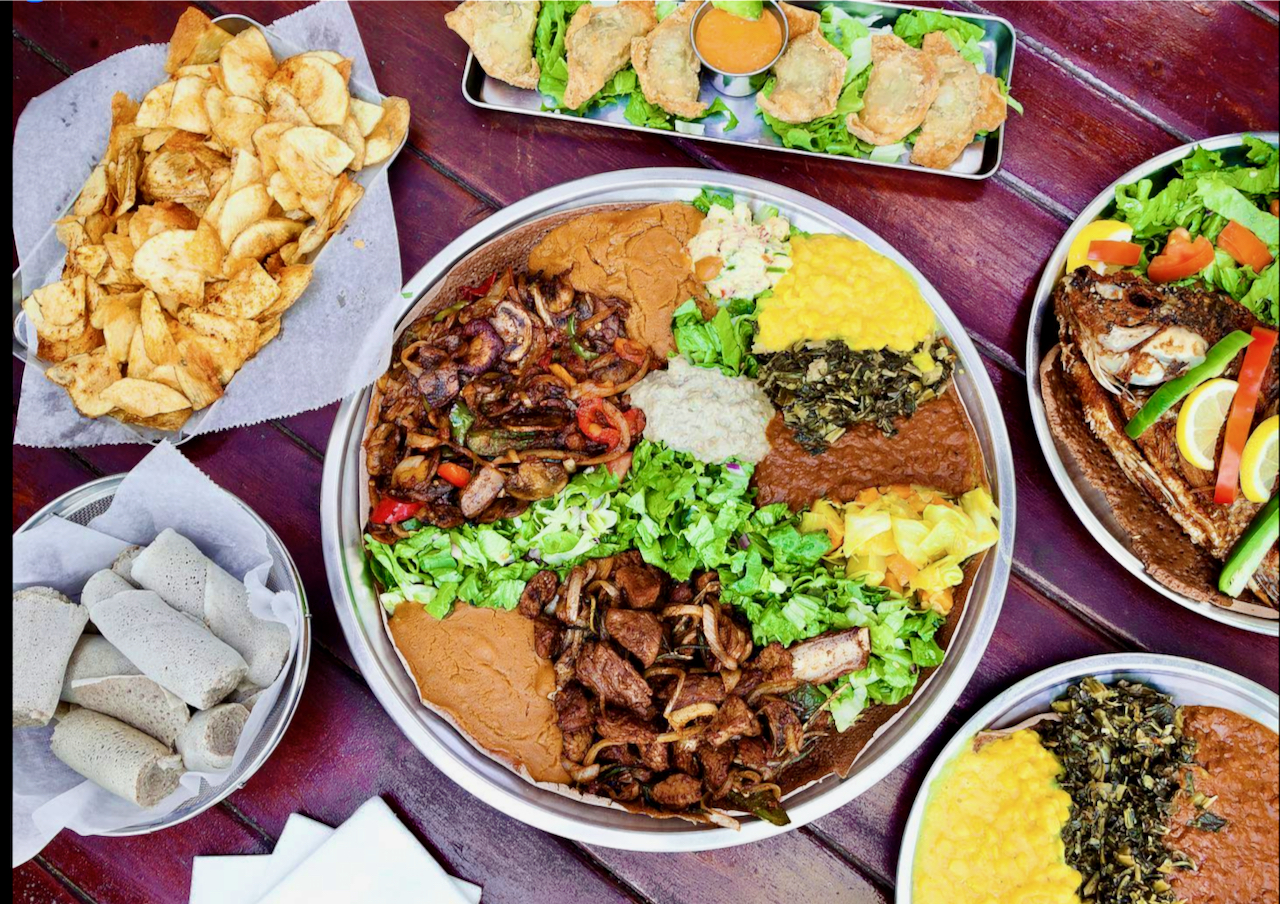
Eating, at it’s best, is a sensory experience. When we’re eating right, we’re seeing the food, smelling it, tasting it, touching it, feeling it in our mouths and to round it out, sharing the experience with people whose company we enjoy. In theory we can do this with any meal. In practice we don’t. With Ethiopian, you can’t help but do it.
By Wanda Hennig
Sections of this story were previously published in Oakland magazine, Black Diamond Living magazine and Durban’s Independent on Saturday.
Ethiopian food is visual and aromatic. Spices and herbs are an integral part of the cooking. The food is colorful. The vegetarian options are the shades of the different types of lentils used, chickpeas, tomatoes, collard greens, peppers and more, infused with garlic, ginger, cardamom and other spices.
The meat options are also a visual medley ranging from finely minced beef that is traditionally eaten raw to the sizzling tibs — lamb, shrimp, cooked beef. Order from the menu and what you get are the different dishes arranged in an artistic abstract on a large round platter in the center of the table.
On the dish, under the food, is a layer of teff injera. This is the spongy Ethiopian bread that is also served, rolled into what resemble napkins. Your fingers and pulled-off pieces of injera are your utensils, which adds to the tactile nature of this cuisine.
I discovered the distinctive delights of the Ethiopian and Eritrean table, they being essentially the same eating experience, while living in the US. The subtle spices. The exotic stews (wots and tibs) both for the carnivore and also for the vegetarian (the grains and pulses cooked to flavour-perfection).
I’ve long been a fan of kitfo, their version of steak tartare — the hand-chopped beef served raw, infused as it is with its unique herb and spice blend, including cardamom and chili and served at room temp … And of the bubbly porous injera “bread”.
Then there is the eating with your hands part, and sharing the meal with friends (because the whole eating experience feels made to share). I think of it as one of my best US culinary discoveries.
Word Play
If you’re a fan of Ethiopian cuisine you may agree that the appeal is a blend of flavor, color, texture and aroma. The most distinctive spice is the classic turmeric-orange berbere made from chili peppers, garlic, ginger, dried basil, korarima (Ethiopian cardamom), rue, white pepper, black pepper and fenugreek.
[First published Oakland magazine]
It helps that the food lends itself to eating family-style and sharing. And that Ethiopia is known as the birthplace of coffee. They’ve been drinking it there since the ninth century when, legend has it, a herder noticed his goats were dancing and tried some of the berries they were eating.
“You cannot be Ethiopian and not be influenced by food,” says Wosene Worke Kosrof.
It is two weeks since Wosene — he typically uses only his first name as is customary in Ethiopia — returned from Addis Ababa to the Berkeley home he shares with his wife, muse and business partner, Patricia diRubbo.
He has a small house with a studio in Addis and goes to work periodically and to mentor promising students. It is less than 24 hours since his most recent exhibition opened at the Bekris Gallery, an upscale space in downtown San Francisco’s artist’s row.
In Berkeley the morning after we are talking art and food and coffee in the kitchen that is a blend of Wosene’s Ethiopian heritage and diRubbo’s Italian-American roots. Every so often we duck into the living room. Both rooms are veritable galleries of Wosene’s work, much of it scheduled to be sent to some gallery or other. We have strolled across the garden to his lofty newly built studio.
Wosene received his Bachelors of Fine Arts degree in 1972 from the School of Fine Arts in Addis. In 1977 he left the country of his birth to further his career as an artist, enrolled at D.C.’s College of Fine Arts at Howard University in 1978, and obtained a Masters of Fine Arts degree in 1980. While at Howard he began a unique artistic journey. He became the first Ethiopian artist to focus on the beauty, plasticity and communicative potential of the written symbols — the letters or script — of his native Amharic, Ethiopia’s unique and official language.
His work — creative, alive, powerful, complex, sometimes playful and often colorful — has been called “a celebration of Africa’s intellectual and cultural achievements.”
Arguable Ethiopia’s best-known living artist, he has paintings in the permanent collection at the Smithsonian National Museum of African Art, the National Museum of Ethiopia — where in 2010 he mounted the biggest exhibition the country has seen “in 50 or 60 years” — the Rockefeller Collection and at the United Nations, among many other august institutions. If you’re in the East Bay you can see his work at the Claremont Hotel’s Terra Firma gallery. If you’re in California wine country, you can see it at Terra Firma’s sister galleries in Sonoma or Healdsburg.
Whether in Addis or Berkeley, Wosene typically begins his day at a coffee shop. He tells me that he will often start the creative process by getting into conversation with himself. Feeling fired up, he will return in haste to his studio and get to work. I have seen him at it — adding paint, scratching at the paint, adding a different color, stepping back and viewing the canvas taped to the wall, which allows for a more robust interaction than if he used an easel.
“Cooking and painting are pretty much the same to me. When I paint it’s like I’m cooking and tasting the letters as I paint them,” he says. “My mouth is tasting the colors. In African the ceremony behind food is a big part of life. It tells about marriage, death, the harvest, life.”
Wosene Kosrof
In the coffee shop he was in conversation with himself. When he paints, “I am in conversation with the canvas. I give it life. It gives me life. Where is it going?” He calls the process “accidental intention.”
Painting is not only like cooking. It is also like making music, says Wosene. Some critics have suggested looking for the riffs and rhythms in his work. “Mazakela, when I listen to him, is not just playing trumpet. What I hear is poetry. What I hear is the poetry of the entirety of human life.”
Similarly his intention with his art is — no borders. “For all human beings everywhere to communicate.”
Amharic-speaking Ethiopians viewers often try to make literal sense of the letters. But that is to limit them. They express Wosene’s world. He is a global citizen. He draws from all the places he has called home. He gets inspiration from scraps of paper, overheard conversations, smells, sadness, love, excitement, joy, freedom, memories. They’re all embedded in the visual field. Like all good artists part of his intention is to help each of us “to see things differently.” The visual feast he scripts makes it impossible not to.
Ethiopia meets the East Bay in your kitchen
[First published in Black Diamond magazine]
Spice is the life of Ethiopian cuisine. The flavorful aromatic dishes can be simple to make if you have the correct medley of essential herbs and spices prepared in the right way.
“The spice blending is complex and getting this right is the foundation of any dish,” says Fetlework Tefferi, chef-owner of Oakland’s popular Café Colucci restaurant and author of Ethiopian Pepper & Spice, a cookbook inspired, Tefferi says, by a desire to document and preserve authentic flavors remembered from her childhood.
Tefferi launched her book at a lunchtime pavement party outside Colucci and her adjoining Brundo Ethiopian Spice Store on a recent sunny Saturday. She signed books next to where store assistant Zafu Belete demonstrated traditional Ethiopian coffee ceremony — a daily (and sometimes several times daily) affair in many Ethiopian homes — while guests nibbled on injera (the spongy bread) and various spicy dips.
The book, says Tefferi, comes after four years of traveling back and forth from the East Bay to Ethiopia looking for the right spice blends for the recipes she wanted to include and more importantly, the right people to put into a small spice blending operation she has set up in Ethiopia to ensure consistency and availability. “I wanted to document the cuisine, where it comes from and how it is sourced,” she says.
“To do this I knew I had to focus on the spices and the blending.” Peppers, she emphasizes, are a defining ingredient; berbere — a “universal” seasoning for most red sauces (wots), meat, veggie and legume dishes and considered an enhancer flavor requiring two weeks for preparation (she explains the process in her book) — being the best known.
Tefferi, who opened her restaurant in 1991, says she has focused on integrity and authenticity in her recipes. At the same time her goal has been to make the food accessible to the home cook. And, she points out, once the essential nature of the spice blend has been preserved, there can be fusion.
“A lot of vegetarian chefs are interested in our spices. And they can be used to enhance and give a new twist to many dishes — even the barbecue.”
Copyright: Wanda Hennig, 2025